

Tube lights are linear lamps designed for uniform general illumination in commercial, industrial, and residential environments. They are widely used in battens, troffers, recessed fixtures, surface-mounted fittings, and vapor-tight luminaires. This product family covers both traditional fluorescent tubes and modern LED tube replacements, allowing customers to choose based on fixture type, budget, energy-saving goals, and maintenance strategy.
1) Fluorescent Tube Light (Traditional)
Overview
Fluorescent tubes use a gas-discharge process inside a coated glass tube to produce light. They require a ballast to operate and, in many installations, a starter (for electromagnetic ballast systems). Fluorescent tubes have been the standard solution for decades due to their wide availability and consistent light distribution.
Key Features
- Proven linear lighting technology with wide fixture compatibility
- Suitable for general area lighting in offices, schools, warehouses, and corridors
- Works with ballast systems (electromagnetic or electronic)
Typical Technical Information (by type/system)
- Types:
- T8 Fluorescent (G13 base, ~26 mm diameter)
- T5 Fluorescent (G5 base, ~16 mm diameter)
- Common Lengths: 600 mm / 1200 mm / 1500 mm (availability depends on market/type)
- Operating System:
- EM/CCG ballast + starter (common in many older T8 fixtures)
- HF/ECG electronic ballast (common in T5 and newer installations)
- Input Voltage: determined by luminaire/ballast (typically 220–240V AC in KSA)
- Light Quality: typically CRI ≥80, multiple CCT options available by lamp code
- Maintenance: lamp replacement required more frequently than LED; ballast/starter condition affects reliability
2) LED Tube Light (Modern Replacement / Retrofit)
Overview
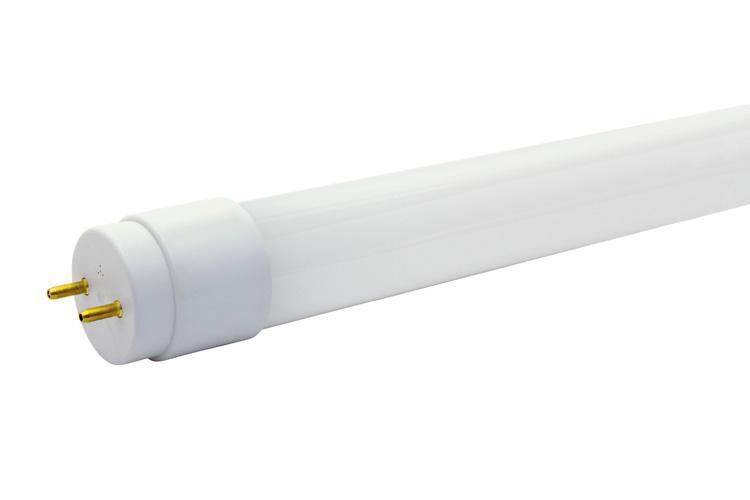
LED tube lights are energy-efficient replacements designed to fit standard tube fixtures while delivering lower power consumption, instant start, longer lifetime, and reduced maintenance. LED tubes are available in different compatibility versions depending on the existing ballast type, or for direct mains wiring.
Key Features
- Energy-saving upgrade vs fluorescent
- Instant start and stable output (no warm-up)
- Long service life and reduced maintenance
- Uniform illumination with wide beam distribution
- Available in multiple lengths and wattages to match brightness requirements
- Retrofit-friendly options based on fixture technology
Technical Specifications (Series Options)
Electrical
- Input Voltage: 220–240V AC, 50/60Hz (series dependent)
- Power Options: 10W / 20W / 30W / 40W / 50W
- Driver: integrated LED driver (series dependent)
- Power Factor: typically ≥0.90 (series dependent)
- Dimming: non-dimmable by default (dimmable versions available by request)
Photometric
- CCT Options: 3000K / 4000K / 6500K (options depend on model)
- CRI: ≥80 (CRI ≥90 available for premium applications)
- Beam Angle: typically wide distribution for general lighting (approx. 160°–200°, model dependent)
Mechanical
- Tube Types: T8 / T5
- Lengths: 600 / 1200 / 1500 mm
- Base/Cap:
- T8: G13
- T5: G5
- Housing: glass or polycarbonate (PC) (model dependent)
- Diffuser: opal/frosted for comfortable output (model dependent)
Operating Conditions
- Operating Temperature: typically -20°C to +45°C (series dependent)
- Environment: indoor use; IP depends on the fixture housing (tube itself is usually IP20)
LED Installation / Compatibility Types (Important)
- EM/CCG compatible (starter retrofit): for magnetic ballast fixtures using LED starter
- HF/ECG compatible (plug-and-play): for supported electronic ballasts
- Direct mains / ballast bypass (rewire): requires rewiring by a qualified electrician
- Universal types: designed to work across multiple driver/ballast technologies (model dependent)
LED Model Options (Power × Length Selection Guide)
- 600 mm: typically 10W / 20W
- 1200 mm: typically 20W / 30W / 40W
- 1500 mm: typically 30W / 40W / 50W
Final brightness (lumens) depends on the LED efficiency class and selected wattage.
Applications (Fluorescent & LED)
- Offices, schools, and corridors
- Warehouses, workshops, and parking areas
- Retail stores and showrooms
- Hospitals, clinics, and public buildings
- Residential garages and utility rooms