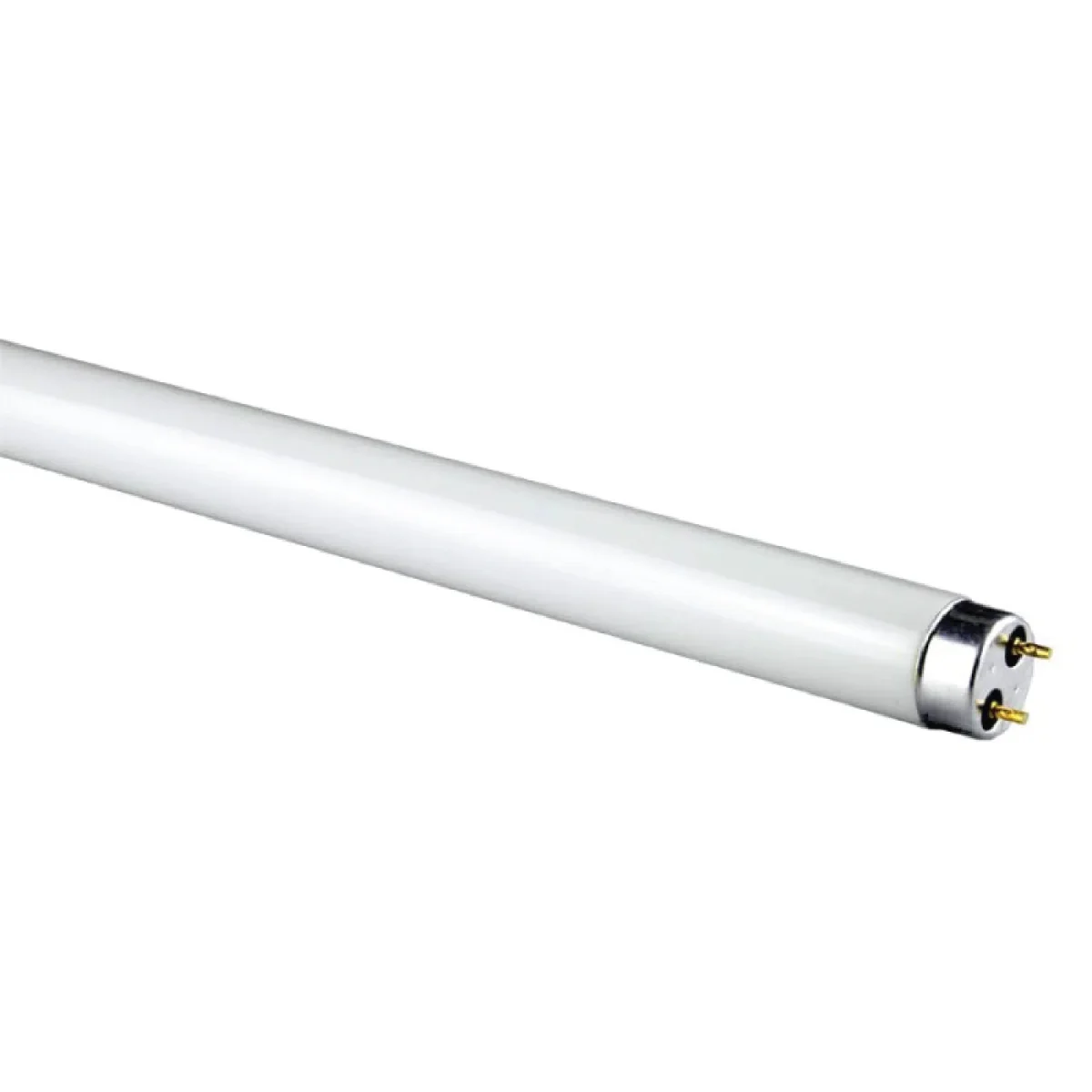



Tube lights are linear light sources designed for uniform general illumination in commercial, industrial, and residential spaces. They are commonly installed in batten fixtures, troffers, indirect coves, and vapor-tight luminaires. The market is divided into two main technologies:
- Fluorescent tubes (traditional)
- LED tubes (modern replacement/retrofit)
LED tubes are engineered to replace fluorescent lamps while reducing energy consumption, improving lifetime, and minimizing maintenance. Many LED tubes are designed to fit existing luminaires using the same caps (bases) such as G13 (T8) or G5 (T5) and follow safety/interchangeability requirements defined for double-capped LED retrofit lamps.
A) Fluorescent Tube Types (Traditional)
1) T8 Fluorescent Tube (G13 base)
- Diameter: 1 inch (≈26 mm)
- Common lengths: 600 mm, 1200 mm, 1500 mm
- Electrical operation: requires a ballast
- CCG/EM (electromagnetic) with a starter
- ECG/HF (electronic/high frequency) without a starter
- Typical applications: offices, corridors, warehouses, schools.
2) T5 Fluorescent Tube (G5 base)
- Diameter: 5/8 inch (≈16 mm)
- Common lengths: 549 / 849 / 1149 / 1449 mm (depending on HE/HO types and regions)
- Electrical operation: typically electronic ballast (HF/ECG)
- Typical applications: offices, retail, continuous rows, cove lighting.
3) T12 Fluorescent Tube (G13 base, legacy)
- Diameter: 1.5 inch (≈38 mm)
- Older, lower efficiency; largely replaced by T8/T5 and LED.
Fluorescent tubes contain mercury and rely on ballast technology; LED tubes are mercury-free and often compliant with modern eco directives (depends on brand/model).
B) LED Tube Types (Modern Replacement)
LED tubes come in multiple “driver/ballast compatibility” types. This is the most important technical difference, because it determines whether the LED tube can be installed as a retrofit or needs rewiring.
1) LED Tube for EM/CCG (Conventional ballast) — “Starter Retrofit”
Also called: EM tube / CCG tube / magnetic ballast compatible
- Designed to run on fixtures with electromagnetic ballast (starter-based systems).
- Usually requires replacing the starter with an LED starter (often included in the packaging).
- Pros: quick retrofit, minimal changes
- Notes: performance depends on ballast condition; old ballasts can reduce reliability.
2) LED Tube for HF/ECG (Electronic ballast) — “Plug-and-Play for ECG”
Also called: HF tube / ECG tube
- Runs on compatible electronic ballasts.
- Compatibility matters (manufacturers provide ballast compatibility lists/tools).
- Pros: very fast upgrade, no rewiring
- Notes: not every ECG is supported; verify before installation.
3) LED Tube Universal (ECG + CCG + Mains) — “One tube for all”
Also called: Universal / UN
- Designed to operate on electronic control gears (ECG/HF), electromagnetic control gears (CCG/EM), or direct mains depending on the installation and luminaire type.
- This reduces SKU stock complexity (one family can cover many sites).
- Example (from your link): OSRAM SubstiTUBE T8 Universal is positioned as “a LED tube for all driver technologies” with common T8 lengths 600 / 1200 / 1500 mm.
4) LED Tube Direct Mains (Ballast Bypass) — “Rewire”
Also called: Mains tube / ballast-free tube
- Requires bypassing/removing ballast and wiring the lampholders to mains.
- Comes in two wiring styles:
- Single-ended power (live/neutral on one end)
- Double-ended power (live one end, neutral the other)
- Safety and interchangeability expectations for retrofit double-capped LED lamps are addressed by IEC 62776.
- Pros: eliminates ballast failures; high reliability
- Notes: rewiring must be done by a qualified electrician; label the luminaire after conversion.
5) LED Tube with Integrated Sensor (Special Type)
- Includes an internal sensor (often microwave) for automatic switching/dimming logic.
- Example: LEDVANCE/OSRAM offers variants with integrated motion sensor.
- Pros: energy savings in parking, storage, corridors
- Notes: verify suitability for enclosed luminaires and sensor behavior.
C) Core Technical Features
Below are the key technical items that differentiate tube lights—these are the specs most buyers request.
1) Mechanical / Form Factor
- Tube type: T8 / T5 / T12 (diameter and cap type)
- Base/cap: G13 (T8/T12) or G5 (T5)
- Length: common T8 LED replacements include 600 / 1200 / 1500 mm.
- Beam angle: LED tubes are often wide distribution (e.g., ~190° for many glass T8).
- Material: glass or polymer; many professional T8 LEDs are glass with shatter protection.
2) Electrical
- Input / operating mode: ECG / CCG / AC mains (depends on tube type)
- Nominal voltage: commonly 220–240V (for mains operation and many systems)
- Wattage: depends on length/output class (typical ranges below)
- Power factor / THD (LED): important in large installations (PF often >0.9; THD limits vary).
- Inrush current: relevant when switching many tubes on a breaker.
3) Photometric / Light Quality
- Luminous flux (lm): total output
- Efficacy (lm/W): efficiency
- CCT codes: 830 (3000K), 840 (4000K), 865 (6500K/daylight) are common options.
- CRI (Ra): typically ≥80, ≥90 optional for premium projects.
- Flicker metrics: important for offices/industry (some product lines specify Pst LM / SVM).
4) Lifetime / Reliability
- Rated life: can range from ~30,000 h (value lines) up to 60,000 h (professional lines).
- Switching cycles: professional tubes can reach very high cycle counts (example shows 200,000).
- Lumen maintenance: e.g., L70 at rated lifetime (70% at end of life).
5) Environmental / Protection
- Operating temperature range: important for cold warehouses/parking. Example ranges include –20 to +50°C for the referenced series story, and –20 to +45°C in an example datasheet.
- IP rating: many tubes are IP20 and rely on the luminaire for environmental protection.
- Shatter protection: PET coating on glass tubes is used for safety in areas like food industry.
- Mercury-free / RoHS: common benefits for LED tubes.