


Last Updated: July 2026
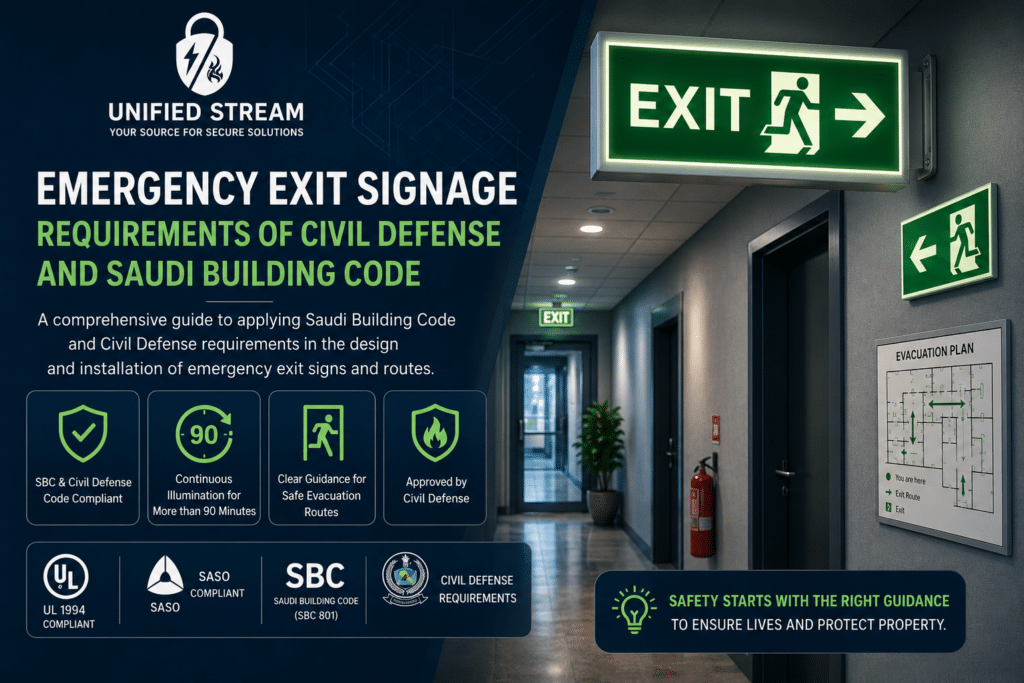
Photoluminescent emergency exit signs are among the most critical safety elements in any commercial, industrial, or residential building. It is not just about hanging a sign pointing to an exit; these signs must strictly comply with Civil Defense requirements and the Saudi Building Code (SBC) directives to ensure quick and safe evacuation during power outages or fires.
Quick Answer
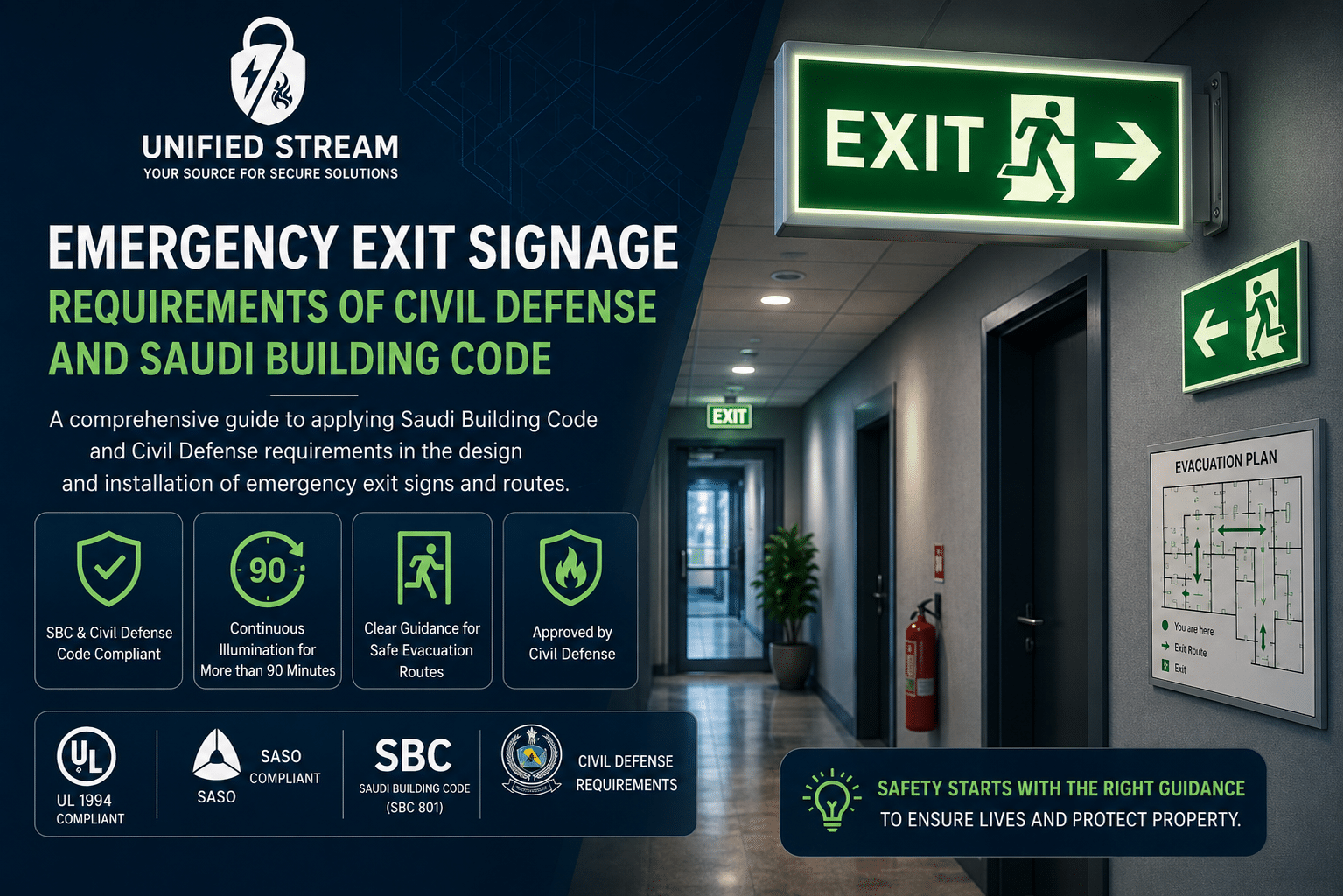
The Saudi Building Code (SBC) and Civil Defense require emergency exit signs to be clearly visible at all times. Self-luminous (Photoluminescent) signs, which absorb light and re-emit it in the dark, are permitted provided they offer continuous illumination for at least 90 minutes during a power outage and are installed at specific heights and sizes to clearly guide occupants to a safe exit.
With the increase of mega-projects in the Kingdom, focusing on non-electrical safety systems has become a primary trend for contractors and safety officers. In this guide, we will review the technical details required to approve evacuation routing signs for your project.
What are Photoluminescent Evacuation Signs?
They are signs and markings made from materials containing phosphorescent pigments that absorb light energy (from ambient natural or artificial lighting) and store it. When sudden darkness occurs due to a power outage, these signs emit a strong yellowish-green glow that safely guides people to escape routes.
This technology has become preferred in Saudi facilities because it does not rely on perishable batteries, requires almost no complex periodic maintenance, and operates at 100% efficiency during crises.
Saudi Building Code (SBC) Requirements for Emergency Exits
The Saudi Building Code sets strict standards for designing escape routes and equipping them with directional signs. Key requirements include:
- Continuity: Luminous signs must remain illuminated and clearly visible for at least 90 minutes after the primary electrical power fails.
- Font Size and Symbols: The height of the letters in the word (EXIT) must not be less than 15 cm (6 inches), and symbols (like the running man icon) must be clear and comply with international standards (ISO 7010).
- Color Contrast: The Saudi Building Code mandates a clear contrast between the text (or symbol) color and the background color to ensure visibility from a distance and in thick smoke conditions.
- Distribution: Signs must be placed so that the distance from any point in the escape route to the nearest visible exit sign does not exceed the allowable distance in the code (which depends on the occupancy type).
Civil Defense Rules for Emergency Signs
In addition to the Saudi Building Code, the Civil Defense heavily focuses on the operational aspect during inspections:
- Doors leading directly to the outside must be equipped with an (EXIT) sign.
- Illuminated directional arrows must be placed to guide people at any change in the direction of the escape route (corridors, intersections).
- Signs must be fire and heat-resistant and withstand the environmental conditions of the location.
- The use of purely reflective signs as an alternative to photoluminescent signs in dark corridors is prohibited.
Comparison: Electrical (LED) vs. Photoluminescent Signs
| Comparison Point | Electrical Signs (with emergency battery) | Photoluminescent Signs |
|---|---|---|
| Power Consumption | Consumes continuous electrical power | Zero consumption (charges from ambient light) |
| Maintenance | Requires battery replacement and periodic testing | Virtually zero maintenance |
| Lifespan | Medium (due to batteries and circuits) | Very long (can exceed 25 years) |
| Reliability during a fire | May fail if wires burn | 100% reliable due to no wiring |
| Saudi Building Code Compliance | Approved (if they achieve 90 minutes) | Approved and preferred for sustainability and cost |
Installation Locations and Legal Heights
According to Saudi Building Code requirements and approved engineering practices, signs must be installed at specific levels:
- High-Level Signs: Installed directly above exit doors or suspended from the ceiling in long corridors. The lower edge of the sign must be no less than 2 meters from the floor level.
- Low-Level Signs: In certain applications (like hospitals and hotels), installing a luminous strip or signs at a low level (less than 45 cm from the floor) is required because smoke rises, making low-level visibility the clearest during a fire.
Are you preparing your project to pass the Civil Defense inspection?
At UniStream, we provide you with the latest photoluminescent emergency exit signs, directional signs, and anti-slip tapes that fully comply with the Saudi Building Code and Civil Defense standards.
Browse safety products and request a quoteCommon Implementation Mistakes
Many contractors make mistakes that could lead to project rejection by safety inspectors, including:
- Placing exit signs in hidden locations behind architectural columns or decorations.
- Using unapproved or poor-quality signs that lose their glow after a few minutes in the dark.
- Failing to provide sufficient ambient lighting (natural or artificial) during the day to charge the photoluminescent signs.
- Neglecting to install directional signs (arrows) in winding corridors.
Final Verdict
Implementing the Saudi Building Code requirements and Civil Defense stipulations is not just a routine procedure to obtain licenses; it is an engineering responsibility to protect lives.
Using self-luminous (photoluminescent) signs provides a smart, sustainable, and long-term cost-effective solution, ensuring your project's escape routes are ready around the clock without worrying about battery or electrical circuit failures.
Frequently Asked Questions (FAQ)
Does an electrical emergency light replace an exit sign?
No, the function of an emergency light is to illuminate the area to prevent tripping, while the function of an exit sign is to guide people toward the escape door. The Saudi Building Code requires the presence of both to achieve safe evacuation.
What is the required illumination duration for emergency exit signs during a power outage?
Local and international regulations dictate that the luminous sign (whether battery-operated or self-luminous) must operate for a minimum of 90 minutes after a power failure.
Are photoluminescent evacuation signs approved by the Civil Defense?
Yes, they are approved and comply with the Saudi Building Code and Civil Defense requirements, provided the products are original, tested, and meet standard specifications such as (UL 1994) and (ASTM).
What is the correct height for installing an EXIT sign?
The high-level sign must be installed so that its lower edge is no less than 2 meters from the floor level, ensuring it is clearly visible to everyone without obstruction.
