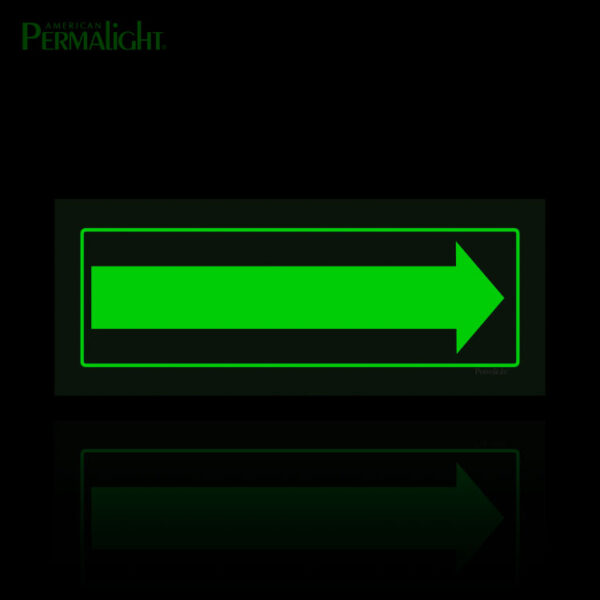


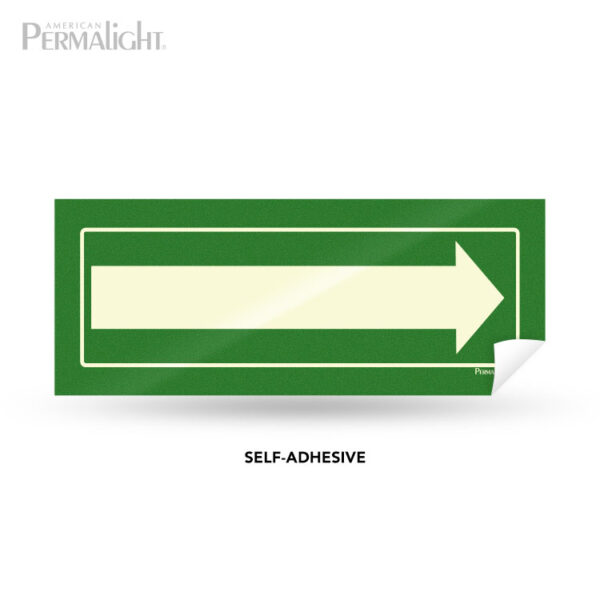
Long Arrow Sign, Self-Adhesive, Photoluminescent Arrow 4 in × 12 in (10.16 cm × 30.48 cm) is a peel-and-stick wayfinding marker built to guide occupants along exit routes, corridors, and stairwells—especially when visibility drops. With a solid green background and a glow-in-the-dark arrow (also known as photoluminescent or luminous), it helps communicate direction quickly at critical route decision points.
One of the most practical advantages is its flexibility: the sign can be flipped to point the arrow in any direction (left, right, up, or down). This makes it easier to standardize your project without stocking multiple arrow versions, while still delivering clear, consistent guidance across the building.
Long Arrow Sign, Self-Adhesive, Photoluminescent Arrow (4 in x 12 in) — Product Overview
This is a long-format directional arrow sign designed for fast visual recognition. Directional arrows are essential in route guidance systems because even if an exit door is clearly marked, people may still hesitate at corners, intersections, stairwell approaches, or corridor splits. A clear long arrow reduces confusion by confirming “this way” instantly.
The photoluminescent arrow charges under normal ambient light and emits visible glow in darkness. This supports low-light wayfinding during power interruptions or reduced lighting. Since glow performance depends on charging conditions and ambient light exposure, the best results come from installing the sign where it receives typical building lighting during normal operation.
Quick Specs
- Size: 4 in × 12 in (10.16 cm × 30.48 cm)
- Background: Solid green
- Graphic: Photoluminescent (glow-in-the-dark) long arrow
- Mounting: Self-adhesive (peel-and-stick)
- Direction: Flip to point in any direction
- Recommended surface: Clean, smooth indoor surfaces
Key Features
- Peel-and-stick installation: Quick mounting without tools, screws, or drilling.
- Glow arrow visibility: Photoluminescent arrow supports guidance in low-light conditions.
- Long format for clarity: The 4×12 layout is easy to recognize from a distance.
- Flip-to-direction flexibility: Use one sign type for multiple arrow directions.
- Clean, professional appearance: Helps maintain consistent wayfinding across a facility.
Why a Long Photoluminescent Arrow Improves Wayfinding
In emergency guidance, clarity and repetition matter. Long-format arrows are easier to interpret quickly than small arrows—especially in busy corridors, large facilities, or areas where occupants may be unfamiliar with the building layout. A long arrow also reinforces direction at a glance without requiring people to move closer.
- Better recognition at a distance: The elongated arrow shape communicates direction more clearly.
- Faster decisions at intersections: Reduces hesitation at corners and corridor splits.
- Route reassurance: Confirms occupants are moving in the correct direction along long paths.
- Low-light support: Photoluminescent arrow helps when lighting drops (charging conditions apply).
Typical Applications
This sign is commonly used for wayfinding and egress route guidance in:
- Exit routes & corridors: At turns, splits, corridor junctions, and long hallways.
- Stairwells: At stair doors, landings, and corridor-to-stair transitions.
- Emergency exit approach paths: To guide occupants toward final exit doors.
- Parking areas (where appropriate): Pedestrian paths, ramps, and elevator lobby approaches.
- Warehouses & industrial facilities: Marking designated safe pathways and route directions.
- Public buildings: Offices, hotels, malls, schools, hospitals, and residential towers.
How to Choose the Correct Arrow Direction (Flip Advantage)
Because the sign can be flipped, you can orient it to match the required direction on-site:
- Left: Use before a left turn or at a junction where the route leads left.
- Right: Use before a right turn or at a junction leading right.
- Up (straight ahead): Use to indicate forward movement on a corridor path.
- Down: Use to indicate downward movement or route continuation to lower levels (as needed).
Best practice: Install arrows at every decision point, then add “reassurance” arrows along long corridors so occupants never wonder if they’re still on the correct route.
Installation Notes (Best Practice)
For best adhesion and a clean finish, apply to a clean, smooth, dry surface. Surface preparation is the main factor that determines long-term bonding performance for peel-and-stick products.
- Clean: Remove dust, oils, and residue using a suitable cleaner.
- Dry completely: Moisture can weaken adhesion.
- Test-position: Confirm direction and alignment before peeling the liner.
- Peel slowly: Avoid touching the adhesive excessively.
- Apply gradually: Press from one edge to reduce air bubbles.
- Press firmly: Apply even pressure across the entire sign for full contact.
Common Mistakes to Avoid
- Installing on rough, porous, dusty, or damp surfaces.
- Placing the sign behind objects that block sightlines (frames, equipment, décor).
- Using inconsistent heights across a route (reduces fast recognition).
- Skipping decision points where direction changes (corners/intersections).
Photoluminescent Performance Notes
Photoluminescent graphics charge under normal ambient lighting and glow in darkness. Performance depends on factors such as light intensity, charge duration, and site conditions. For best results, install where the sign receives routine building lighting and avoid placing it in consistently dim areas that may reduce charging.
If your project requires specific performance targets, align product selection and placement with your site’s risk assessment, building plan, and any relevant requirements. Using directional arrows together with consistent exit symbols and route identifiers creates a stronger overall guidance system.
Maintenance & Cleaning
Routine cleaning helps keep the sign readable and professional-looking. In most indoor environments:
- Wipe gently with a soft cloth as part of regular cleaning schedules.
- Avoid abrasive pads or harsh chemicals that may scratch the surface.
- Inspect periodically in high-traffic areas (stair doors, junction points) to ensure edges remain firmly bonded.
Build a Complete Exit-Route Wayfinding System
Directional arrows work best as part of a complete signage plan:
- Exit symbols on doors: Mark the final exits clearly.
- Directional arrows at decision points: Confirm turns and corridor splits.
- Stairwell identification: Reinforce floor/zone identity along the route.
- Consistency: Keep style, placement height, and spacing consistent across the facility.
This approach improves recognition and reduces decision time—supporting smoother movement in busy buildings.
Helpful External Resources
For general egress and life-safety references, you can review:
- OSHA – Means of Egress (1910.37)
- NFPA – Codes & Standards
- ISO – Safety Signs (ISO 7010 reference page)
FAQ
1) What is the size of this sign?
Each sign measures 4 in x 12 in.
2) Can the arrow point different directions?
Yes. You can flip the sign to point the arrow in any direction (left/right/up/down).
3) Does it require tools or drilling?
No. It is peel-and-stick with self-adhesive backing—no screws required.
4) What surfaces does it stick to best?
Clean, smooth, dry indoor surfaces (walls, doors, glass panels, and similar smooth finishes) provide the best adhesion.
5) Will it work on textured or dusty surfaces?
Adhesion may be reduced on textured, porous, dusty, or damp surfaces. Smooth and well-cleaned surfaces are recommended.
6) Does it glow in the dark?
The arrow is photoluminescent (glow-in-the-dark). Glow performance depends on charging conditions and ambient lighting exposure.
7) Where should I install it for best results?
Place at route decision points (corridor turns, intersections, stairwell entries) and add reassurance arrows along long corridors.