


Last Updated: July 2026
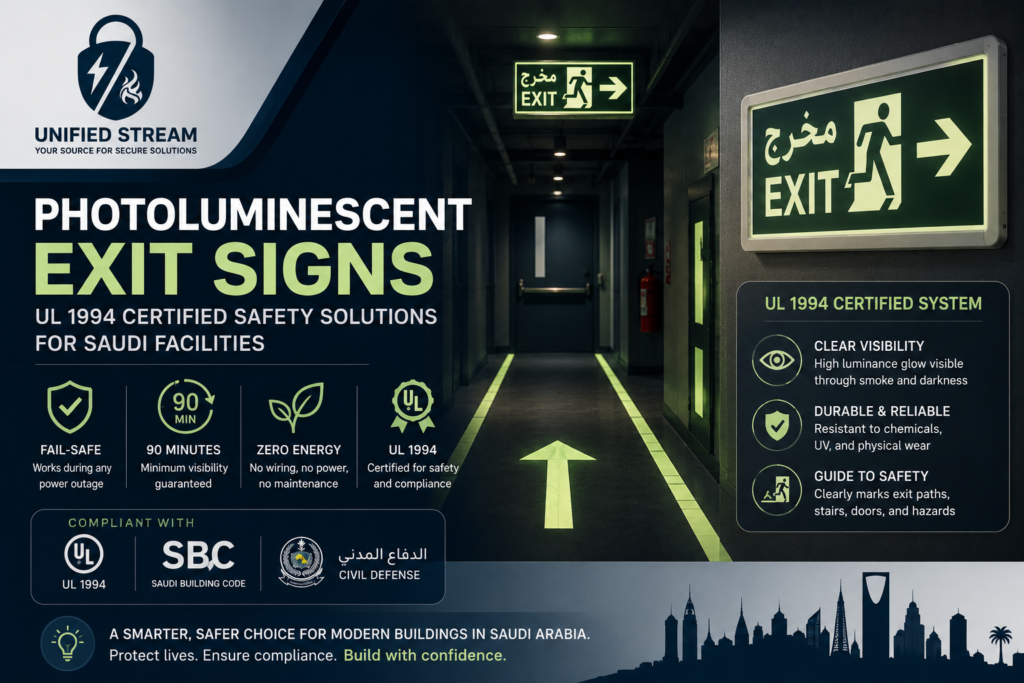
When the power fails during an emergency, a safe and visible evacuation path is the difference between life and death. For modern Saudi facilities, relying solely on battery-powered backup lights is no longer enough. Enter photoluminescent exit signs—a zero-energy, fail-safe solution that is rapidly becoming the standard across the Kingdom.
The Quick Answer
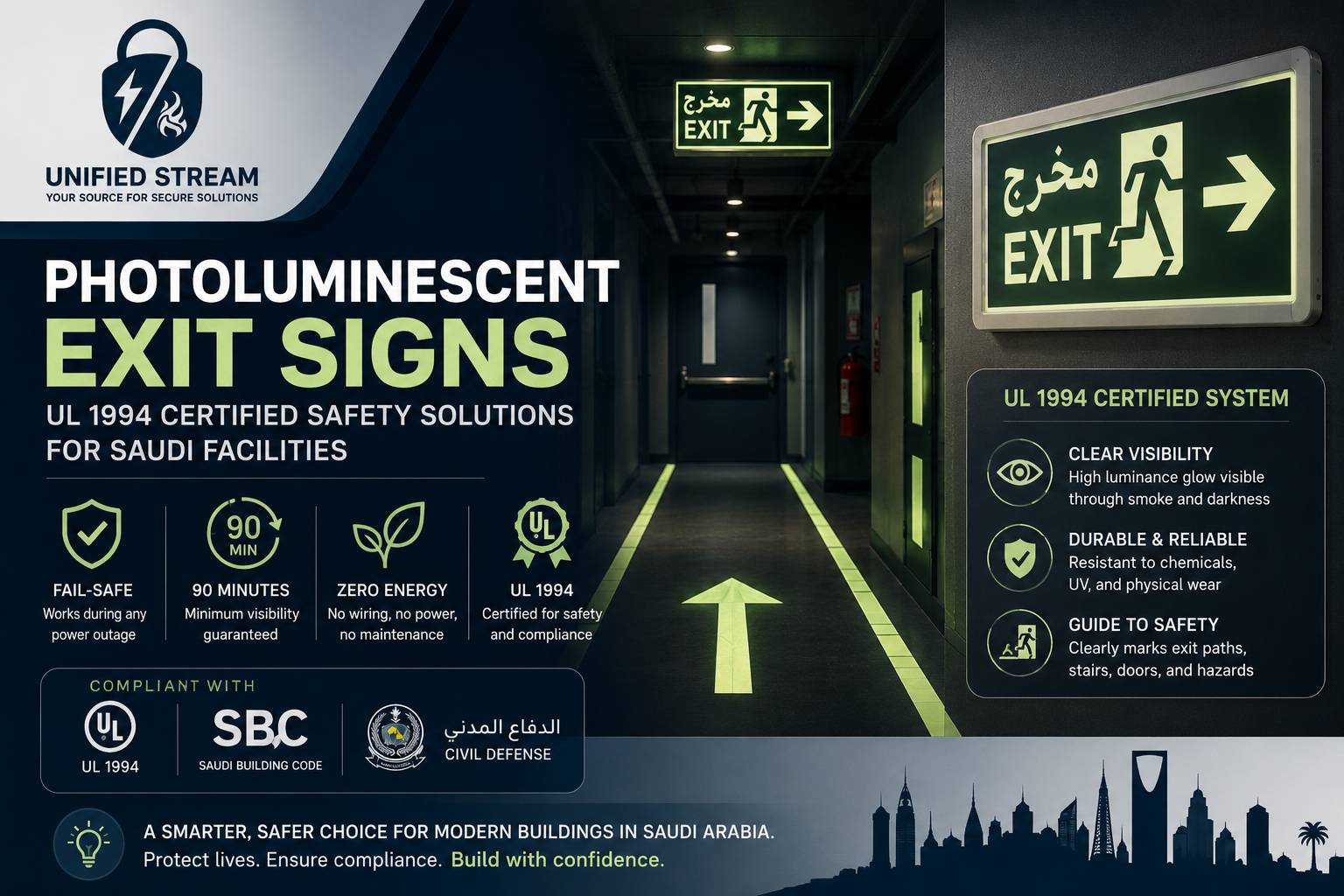
Photoluminescent exit signs absorb ambient light and glow brightly in the dark without any electrical power. To meet Saudi Building Code (SBC) and Civil Defense requirements, these signs must comply with the UL 1994 standard, ensuring they provide a minimum of 90 minutes of clear, visible illumination during a power outage to safely guide occupants to safety.
Whether you are outfitting a new high-rise in Riyadh, a hospital in Jeddah, or an industrial facility in Dammam, understanding the UL 1994 standard and how to properly integrate glow-in-the-dark signage is crucial for full regulatory compliance and maximum safety.
How Do Photoluminescent Exit Signs Work?
The technology is based on special strontium aluminate pigments. These non-toxic, non-radioactive materials absorb UV and visible light from everyday ambient lighting (like fluorescent or LED office lights).
When the environment suddenly goes dark, the stored energy is released as a highly visible, yellow-green glow. Because they rely on ambient light to "charge," they require absolutely no wiring, no electricity, and no backup batteries to function during an emergency.
Understanding the UL 1994 Standard
UL 1994 is the definitive safety standard issued by Underwriters Laboratories for Luminous Egress Path Marking Systems. For photoluminescent exit signs to earn this certification, they must pass rigorous testing:
- Duration and Luminance: The sign must glow brightly enough to be seen through smoke and darkness for a minimum of 90 minutes.
- Charging Capability: It must be able to reach a full charge under standard interior lighting conditions (usually around 1 foot-candle of illumination) within a specific timeframe.
- Durability: The material must withstand environmental factors such as cleaning chemicals, UV degradation, and physical wear, ensuring long-term reliability.
Why Saudi Facilities are Making the Switch
The Saudi Building Code (SBC) and Saudi Civil Defense have heavily emphasized sustainable, fail-proof safety systems. Facilities across KSA are adopting this technology for three main reasons:
- 100% Reliability: Unlike electrical signs that fail if wires burn or batteries die, photoluminescent signs always work.
- Zero Maintenance Costs: No more monthly battery checks, bulb replacements, or electrical testing. Once installed, they require almost zero upkeep.
- Energy Efficiency (Zero Power): In large facilities with hundreds of exit signs, eliminating the continuous power draw of electrical signs significantly reduces the building's carbon footprint and energy bills.
Photoluminescent vs. Electrical (LED) Exit Signs
| Feature | Photoluminescent Signs | LED Electrical Signs |
|---|---|---|
| Power Consumption | Zero (0W) | Continuous (approx. 2W - 5W) |
| Maintenance Required | Minimal (Dusting only) | High (Battery & bulb checks) |
| Lifespan | 25+ Years | 5-7 Years (Battery limits) |
| Wiring Needed? | No | Yes (Conduits & electrical labor) |
| Reliability in Fire | Excellent (No wires to burn) | Vulnerable to wire damage |
Secure Your Facility with UL 1994 Certified Signs
Ensure full compliance with Saudi Civil Defense and SBC requirements. UniStream provides premium, highly visible photoluminescent egress path markings for commercial, medical, and industrial applications.
Browse Safety ProductsCrucial Installation Requirements
To remain compliant with UL 1994 and the Saudi Building Code, you cannot simply stick a sign anywhere. The installation environment is key:
Constant Charging Source: The area where the sign is installed MUST be illuminated by a reliable light source (minimum 54 lux or 5 foot-candles) during all times the building is occupied. If you place a photoluminescent sign in a dark, unlit hallway, it will not charge and will fail during an emergency.
Common Mistakes to Avoid
- Using Uncertified Tape: Standard glow tape bought from a hardware store is not UL 1994 certified and will be rejected by safety inspectors.
- Blocking the Light Source: Installing signs too close to ceilings where light fixtures cannot cast direct light on them, preventing them from properly charging.
- Ignoring Low-Level Markings: In addition to upper exit signs, UL 1994 systems often require floor-level luminous strips along baseboards and stairs, as smoke rises and obscures high signs during a fire.
Final Verdict
For Saudi contractors and facility managers, transitioning to UL 1994 certified photoluminescent exit signs is one of the smartest safety investments available.
They drastically reduce installation and maintenance costs, completely eliminate energy consumption, and provide an unbreakable, fail-safe layer of protection that guarantees a visible path to safety when it matters most.
Frequently Asked Questions
Do photoluminescent exit signs meet the Saudi Building Code (SBC)?
Yes. As long as the signs are tested and certified to recognized standards like UL 1994 or ASTM E2072, and are installed in an environment with sufficient ambient charging light, they are fully accepted under the SBC and by Saudi Civil Defense.
How long do photoluminescent exit signs last?
Because they have no electrical components, batteries, or bulbs to burn out, high-quality photoluminescent signs can last 25 years or more with virtually no degradation in performance.
Can I install them in completely dark areas?
No. Photoluminescent signs require ambient light (from fluorescent, LED, or natural daylight) to charge. If a hallway is perpetually dark, an electrical exit sign must be used, or the lighting design must be changed.
Are these signs radioactive or toxic?
No. Modern photoluminescent signs utilize strontium aluminate, which is completely non-toxic, non-radioactive, and environmentally friendly. Older technologies (like Tritium) were radioactive, but they are largely obsolete now.
