


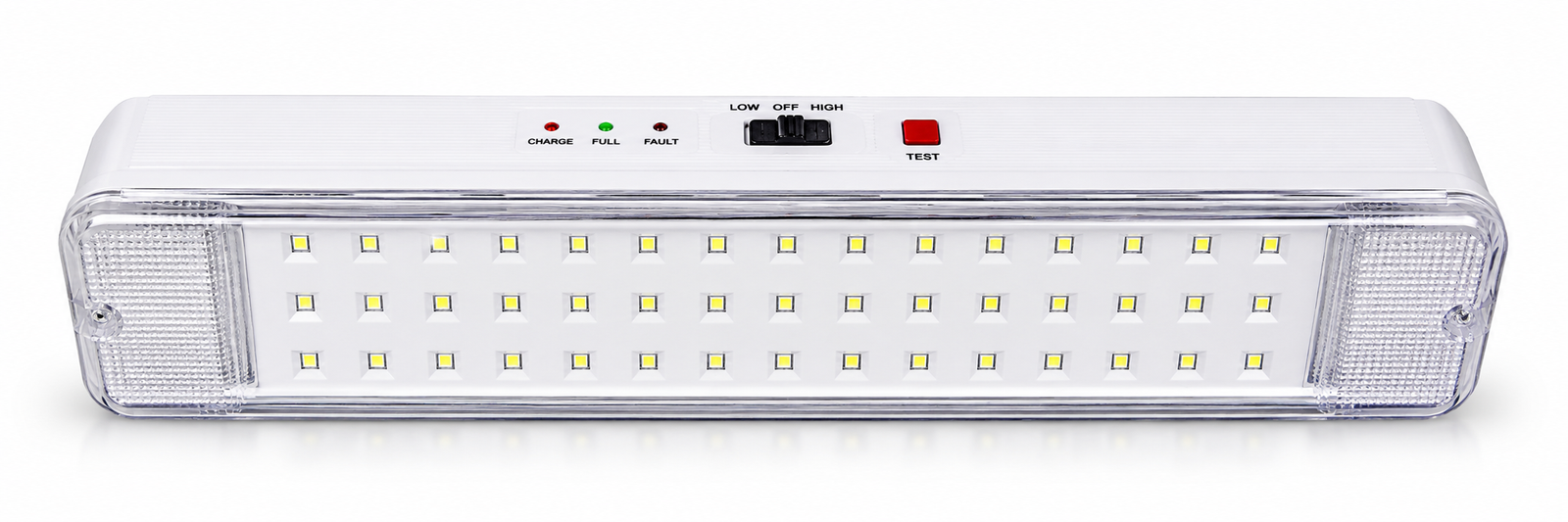
Rechargeable LED Emergency Lights – Portable & Wall-Mounted Backup Lighting
What Are Rechargeable LED Emergency Lights?
Rechargeable LED Emergency Lights are battery-powered lighting devices designed to provide temporary illumination during electrical power interruptions. They are commonly used in residential, commercial, industrial, and public buildings to support visibility and movement when normal lighting becomes unavailable.
Equipped with energy-efficient LED technology and rechargeable batteries, these lights provide practical backup illumination for corridors, stairways, offices, warehouses, workshops, and other indoor facilities.
Available in multiple sizes, LED configurations, battery capacities, brightness levels, operating durations, and mounting arrangements, rechargeable emergency lights offer flexible solutions for different building and project requirements.
Key Features & Benefits
- Emergency Backup Lighting: Provides temporary illumination during electrical power failures.
- Energy-Efficient LED Technology: Offers efficient illumination with relatively low electrical consumption.
- Rechargeable Battery System: Available with different battery technologies and capacities depending on the model.
- Multiple LED Configurations: Different LED quantities and lighting outputs to suit various applications.
- High & Low Brightness Modes: Selected models offer adjustable brightness levels to balance illumination and operating duration.
- Extended Operating Duration: Various battery backup durations are available depending on the manufacturer, battery configuration, and lighting mode.
- Automatic Emergency Activation: Selected models automatically illuminate when the normal electrical supply fails.
- Battery Charging Indicators: Selected models feature LED indicators showing charging or battery status.
- Battery Protection: Certain models include overcharge protection and low-voltage cut-off functions.
- Flexible Installation: Portable, wall-mounted, surface-mounted, and recessed configurations depending on the product design.
- Multiple Protection Ratings: Indoor and higher-IP-rated models are available for different installation environments.
- Easy Maintenance: Selected models provide accessible controls, test functions, and replaceable batteries.
Types of Rechargeable LED Emergency Lights
Portable Rechargeable Emergency Lights
Portable emergency lights are designed for convenient placement and temporary illumination during power interruptions.
Depending on the model, they may include carrying handles, integrated charging systems, and different brightness settings.
Common Applications:
- Residential backup lighting
- Maintenance activities
- Temporary indoor illumination
- Workshops and utility rooms
Wall-Mounted Emergency Lights
Wall-mounted emergency lights are designed for fixed installation on suitable wall surfaces.
Selected models provide automatic emergency illumination when the normal electrical supply is interrupted.
Common Applications:
- Corridors and hallways
- Stairways and building circulation areas
- Offices and commercial buildings
- Industrial and maintenance facilities
Recessed Emergency Lights
Recessed emergency lights are designed for integration into compatible wall or ceiling structures using appropriate mounting accessories.
These configurations provide a more integrated architectural appearance where supported by the manufacturer.
Common Applications:
- Commercial interiors
- Office buildings
- Hotels and hospitality facilities
- Architectural emergency lighting installations
Battery Types & Capacities
Rechargeable LED emergency lights are available with different battery technologies depending on the manufacturer and product design.
Common battery technologies may include:
- Lithium-Ion (Li-ion): Rechargeable battery technology used in various compact emergency lighting products.
- Lithium Iron Phosphate (LiFePO4): Rechargeable lithium battery chemistry available in selected emergency lighting systems.
- Nickel-Cadmium (Ni-Cd): Battery technology used in certain emergency lighting applications.
- Nickel-Metal Hydride (Ni-MH): Rechargeable battery technology available in selected lighting devices.
Battery capacities may vary from smaller configurations to higher-capacity systems, depending on the required operating duration and lighting output.
Important: Battery capacity alone does not determine emergency operating duration. Battery voltage, LED power consumption, driver efficiency, battery condition, and selected lighting mode must also be considered.
High & Low Lighting Modes
Selected rechargeable emergency lights feature multiple brightness settings to accommodate different lighting requirements.
High Brightness Mode
Provides higher illumination output for applications requiring increased visibility.
High mode generally consumes more battery power and may result in a shorter operating duration.
Low Brightness Mode
Provides reduced illumination output to conserve battery energy and extend operating duration.
Low mode may be suitable for applications where lower illumination levels are acceptable.
Reference Example: A rechargeable emergency light with 48 LEDs and a 3.7V 2200mAh battery may provide approximately 3.5 hours in High mode and 7 hours in Low mode, as specified for the KHIND EM2025LD reference model.
Actual operating durations depend on the selected product.
Technical Specifications
| Parameter | Possible Specifications |
|---|---|
| Product Type | Rechargeable LED Emergency Light |
| Lighting Technology | LED / SMD LED |
| LED Quantity | Model-dependent; multiple configurations available |
| Input Voltage | 110–120V / 220–240V / 100–240V AC, depending on model |
| Frequency | 50/60Hz, depending on model |
| Rated Power | According to manufacturer specifications |
| Battery Type | Li-ion / LiFePO4 / Ni-Cd / Ni-MH |
| Battery Capacity | Various capacities depending on model |
| Battery Voltage | According to battery configuration |
| Emergency Duration | Model-dependent; various backup durations |
| Lighting Modes | Single Mode / High & Low / Multi-Mode |
| Recharge Time | According to manufacturer specifications |
| Luminous Flux | Model-dependent, measured in lumens (lm) |
| Colour Temperature | According to selected LED configuration |
| Charging Indicator | Available on selected models |
| Battery Protection | Overcharge / Low-Voltage Cut-Off, depending on model |
| Mounting Type | Portable / Wall-Mounted / Surface-Mounted / Recessed |
| IP Rating | According to selected model |
| Housing Colour | White / Other available finishes |
| Operating Temperature | According to manufacturer specifications |
| Applicable Standards | Subject to manufacturer certification and project requirements |
Technical specifications vary by manufacturer and model. All selected configurations must be verified against the corresponding product datasheet.
Emergency Operation & Battery Charging
Rechargeable emergency lights use internal batteries to provide temporary lighting when normal electrical power is unavailable.
Depending on the model, the device may automatically activate during a power interruption or require manual switching.
When connected to a compatible electrical supply, the charging system replenishes the battery according to the manufacturer’s specified charging cycle.
Selected models include battery charging indicators, automatic charging control, overcharge protection, and low-voltage protection.
Emergency lighting duration must be verified according to the selected brightness mode, battery condition, and manufacturer’s rated performance.
Common Applications
Residential Buildings
Backup lighting for homes, villas, apartment buildings, residential corridors, and utility areas.
Commercial Buildings
Offices, shopping malls, hotels, restaurants, retail facilities, and commercial corridors.
Industrial Facilities
Factories, warehouses, workshops, production facilities, and maintenance areas.
Hospitals & Healthcare Facilities
Selected models may be used in suitable areas of hospitals, clinics, and healthcare facilities, subject to the approved emergency lighting design.
Educational Facilities
Schools, universities, training centers, classrooms, and common circulation areas.
Public Buildings
Government facilities, public service buildings, transport facilities, and other indoor environments.
Maintenance & Utility Applications
Temporary backup illumination for electrical rooms, maintenance activities, equipment areas, and utility spaces.
How to Select the Right Rechargeable LED Emergency Light
When selecting a rechargeable emergency light, consider:
- Lighting Output: Choose the required luminous flux and illumination distribution for the intended area.
- LED Configuration: Select the appropriate LED arrangement and lighting performance.
- Battery Capacity: Verify battery capacity, voltage, chemistry, and compatibility with the lighting system.
- Emergency Duration: Confirm the required backup operating time for the application.
- Lighting Modes: Determine whether single, High/Low, or multiple brightness modes are needed.
- Operating Voltage: Ensure compatibility with the available electrical supply.
- Mounting Type: Select portable, wall-mounted, surface-mounted, or recessed installation.
- IP Rating: Choose suitable environmental protection for the installation location.
- Battery Charging & Protection: Review charging time, status indicators, and available battery protection features.
- Project Compliance: Verify applicable emergency lighting standards, product certifications, and project specifications.
Standards & Compliance
Depending on the product design and intended market, relevant emergency lighting requirements may include IEC 60598-2-22, UL 924, and applicable national electrical and life-safety regulations.
Compliance must be confirmed through valid manufacturer documentation and certification for the exact product model.
For projects in Saudi Arabia, the applicable Saudi Building Code, Civil Defense requirements, and approved project specifications should be reviewed before product selection.
Portable rechargeable lights should not automatically be considered compliant substitutes for permanently installed emergency lighting systems.
Why Choose Unified Stream?
Unified Stream supplies electrical, lighting, and safety-related products for residential, commercial, industrial, and public projects across Saudi Arabia.
We support electrical contractors, project engineers, consultants, procurement departments, and facility maintenance teams through:
- Multi-brand emergency lighting sourcing
- Different LED configurations and battery capacities
- Multiple lighting modes and backup duration options
- Technical specification matching
- Bulk orders and project-based supply
- Competitive project quotations
- Nationwide delivery and supply support
Request a Quote
Contact Unified Stream with your required LED quantity, battery capacity, emergency operating duration, brightness mode, mounting type, IP rating, preferred brand, and quantity to receive a quotation tailored to your project requirements.


