


Last Updated: July 2026
Choosing electrical circuit breakers in Saudi projects depends on more than just the current rating printed on the breaker. You must determine the required protection type, load size, cable capacity, expected short-circuit current, tripping curve, earth leakage sensitivity, and the nature of the connected devices before deciding between an RCBO, RCCB, or MCB.
Quick Answer
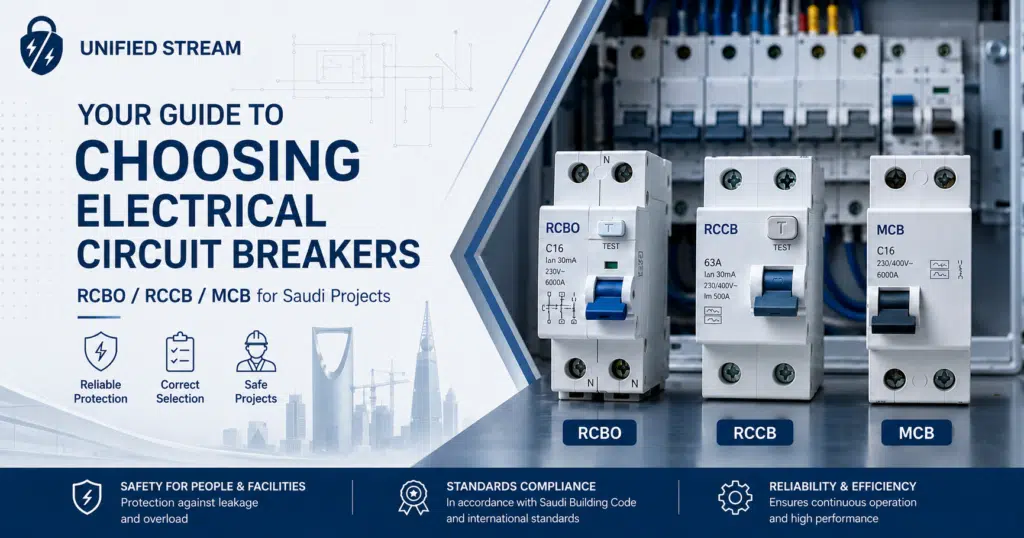
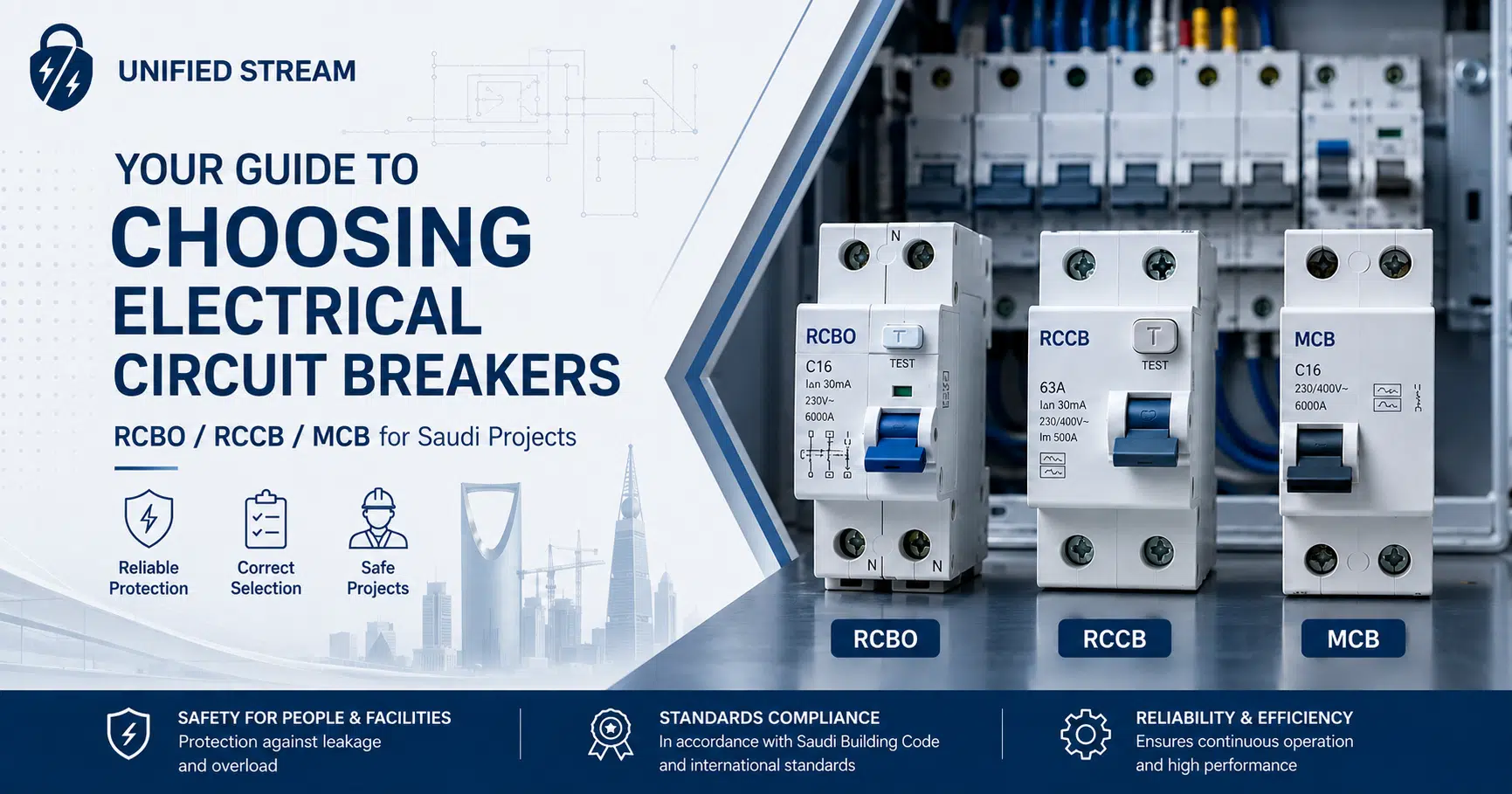
An MCB is used for protection against overloads and short circuits, while an RCCB is used to detect earth leakage and does not provide overload or short-circuit protection on its own. An RCBO combines both functions within a single device, making it suitable when each electrical circuit requires independent protection, thereby minimizing the impact of faults on other circuits.
There is no single type of breaker that suits all projects. Using an MCB with an RCCB might be economical in some distribution boards, whereas an RCBO is more suitable for villas, offices, restaurants, and critical circuits that require operational continuity and fault isolation to a single circuit.
What are Electrical Circuit Breakers?
Electrical circuit breakers are protective devices that disconnect the power supply when an abnormal condition is detected in the circuit. This condition could be an overload, a short circuit, or current leaking to the earth, depending on the breaker type and its built-in protection functions.
The primary function of a breaker is not merely to switch electricity on and off manually, but to protect cables, equipment, and users from the hazards of electrical faults. Therefore, a breaker should never be chosen based solely on its price or ampere rating.
The breaker must be compatible with the grid's voltage and frequency, the number of poles, the load type, the cable's carrying capacity, the expected short-circuit current at its installation point, as well as the temperature and ventilation conditions inside the distribution board.
Difference between RCBO, RCCB, and MCB
| Comparison Element | MCB | RCCB | RCBO |
|---|---|---|---|
| Overload | Yes | No | Yes |
| Short Circuit | Yes | No | Yes |
| Earth Leakage | No | Yes | Yes |
| Independent Circuit Protection | Only from overload & short circuits | Often protects a group of circuits | Comprehensive protection for a single circuit |
| Need for an Extra Device | Needs RCD if leakage protection is required | Needs separate overcurrent protection | Combines both protections in one device |
| Initial Cost | Relatively low | Economical for protecting multiple circuits | Higher per circuit |
| Operational Continuity | Depends on panel design | One fault may trip several circuits | Best at isolating the affected circuit |
| Best Use | Lighting circuits and general loads with separate leakage protection | Group leakage protection alongside MCBs | Sockets, kitchens, and critical/independent circuits |
What is an MCB?
MCB stands for Miniature Circuit Breaker. It is used to protect the circuit and cable from overloads and short circuits.
When the current exceeds allowable limits for a certain period, the thermal tripping mechanism inside the breaker activates. If a short circuit occurs, causing a massive and rapid current spike, the magnetic tripping mechanism engages.
When to use an MCB?
- Lighting circuits.
- General socket circuits.
- Air conditioning and home appliance circuits.
- Small residential and commercial panels.
- Final circuits with low to medium currents.
What does an MCB NOT provide?
A standard MCB does not detect small earth leakages that might pass through a human body or damaged insulation. Therefore, having an MCB alone should not be considered a substitute for an RCCB or RCBO when earth leakage protection is required.
What is an RCCB?
RCCB stands for Residual Current Circuit Breaker. This breaker compares the outgoing current through the live conductor with the returning current through the neutral.
Under normal conditions, both values are balanced. If some current leaks to the earth, a difference between the outgoing and returning current emerges. Once this difference reaches the predefined trip level, the RCCB disconnects the circuit.
What protection does an RCCB provide?
- Detects earth leakage.
- Reduces the risk of electric shock when the appropriate sensitivity is used.
- Helps mitigate fire risks caused by leakage currents.
Does an RCCB protect against overloads or short circuits?
No. The ampere rating printed on an RCCB represents the current the device can carry under specified conditions, but it does not mean it provides overload protection.
Therefore, an RCCB must be coordinated with an MCB, a fuse, or an appropriate protective breaker to prevent currents that exceed the capacity of the RCCB and its connected cables.
When is an RCCB suitable?
It is an economical choice when you want to provide leakage protection for a group of circuits, provided each circuit has separate overload and short-circuit protection using an MCB.
However, placing too many circuits on a single RCCB can lead to all of them tripping if a leak occurs in just one circuit. Furthermore, the accumulation of natural leakage currents from electronic devices might cause nuisance tripping.
What is an RCBO?
RCBO stands for Residual Current Operated Circuit Breaker with Integral Overcurrent Protection. It is a breaker that combines both MCB and RCCB protections within a single unit.
An RCBO can disconnect the circuit upon detecting an overload, a short circuit, or an earth leakage. Thus, it is typically used to protect a single final circuit independently.
Advantages of an RCBO
- Combines multiple protection functions in one device.
- Helps quickly identify which circuit has the fault.
- Reduces the likelihood of a power outage affecting a large group of circuits.
- Suitable for critical loads, wet areas, and sockets.
- Helps divide the panel and improves operational continuity.
Disadvantages of an RCBO
- Its initial cost is higher than a standard MCB.
- Equipping all circuits with RCBOs can increase the overall panel cost.
- You must carefully select the leakage type, trip curve, and capacity, rather than just relying on the fact that it is an RCBO.
How to Choose Circuit Breakers for Saudi Projects
Choosing circuit breakers should be part of the protection system design, not an isolated purchasing task. Below are the key criteria to review.
1. Determine the Required Protection Function
Ask yourself first: Does the circuit need protection against overloads and short circuits only, or does it also require earth leakage protection?
- MCB: For overloads and short circuits.
- RCCB: For earth leakage (requires separate overcurrent protection).
- RCBO: For overloads, short circuits, and leakage in one device.
2. Calculate the Actual Load Current
The design current must be calculated based on the load capacity, voltage, number of phases, power factor, and efficiency if necessary, as well as how the loads are operated.
Blindly summing up the nominal capacities of devices is insufficient, especially in projects featuring motors, air conditioners, or intermittently operated equipment.
3. Coordinate the Breaker with the Cable
The breaker's rating must not allow a current that exceeds the cable's allowable capacity after applying correction factors for temperature, cable grouping, installation method, insulation, and ventilation.
Installing a high-amp breaker on a small cable might allow the cable to overheat before the breaker trips, which is a critical installation error.
4. Determine the Suitable Breaking Capacity
Breaking capacity, such as 6kA, 10kA, or 15kA, indicates the short-circuit current level the breaker can safely interrupt according to a specific standard.
The breaking capacity must be equal to or greater than the expected short-circuit current at the installation point. Do not assume 6kA is suitable for all panels, especially near transformers or in commercial and industrial projects.
5. Choose the Number of Poles
| Number of Poles | Common Use | Note |
|---|---|---|
| 1P | Disconnecting the phase in single-phase circuits | Does not disconnect the neutral |
| 1P+N | Single-phase circuits | Provides phase and neutral disconnection depending on device design |
| 2P | Phase and neutral or a two-conductor circuit | Review the protection and disconnection method for each pole |
| 3P | Three-phase loads without neutral | Such as certain motors |
| 4P | Three-phase systems with neutral | Crucial in applications needing all live conductors disconnected |
6. Review Operating Voltage and Frequency
Ensure the breaker is compatible with the project's actual power supply system. Modern low-voltage facilities in Saudi Arabia typically use 230/400V systems at 60Hz. Always refer to the approved power supply data for each project.
7. Review the Temperature Inside the Panel
High temperatures inside distribution boards can affect breaker performance and current-carrying capacity. This is particularly important in Saudi Arabia, especially for outdoor panels or poorly ventilated electrical rooms.
You must review the manufacturer's derating tables and calculate the impact of adjacent breakers and the actual temperature inside the panel, not just the ambient outdoor temperature.
8. Review Selectivity Between Breakers
Selectivity (or discrimination) means the breaker closest to the fault trips first without tripping the main breaker or affecting unaffected circuits.
Selectivity is not achieved merely by choosing a main breaker with a higher amp rating. It requires reviewing time-current curves and coordination tables issued by the manufacturer.
9. Verify Standards and Certificates
Determine the standard required in the project specifications, verify the product's compliance, and check for test reports and approvals accepted within the Saudi market.
| Device Type | Common Reference Standard |
|---|---|
| MCB for household and similar uses | IEC 60898-1 |
| RCCB without built-in overcurrent protection | IEC 61008-1 |
| RCBO with built-in overcurrent protection | IEC 61009-1 |
| Industrial use breakers | IEC 60947-2 |
| RCD Types F and B | IEC 62423 with associated standards |
Choosing Tripping Curve B, C, or D
The tripping curve determines how well the breaker tolerates high instantaneous currents before the magnetic tripping mechanism engages. Do not confuse the curve letter with the ampere rating.
Curve B
Typically used for loads with low starting currents, such as some lighting circuits, resistive loads, and simple residential circuits.
Curve C
Widely used in residential and commercial applications with medium inrush currents, such as some AC units, commercial lighting, and equipment with inductive components.
Curve D
Used for loads with high starting currents, like specific motors, transformers, and specialized equipment. It should not be used simply to prevent nuisance tripping without studying the short-circuit current, tripping time, and cable protection.
Choosing Earth Leakage Sensitivity
Leakage sensitivity is measured in milliamperes (mA) and determines the residual current value at which the protective device begins to trip.
30mA Sensitivity
Commonly used as additional protection for individuals in final circuits, sockets, and areas requiring a high level of protection, per code requirements and the nature of the location.
100mA or 300mA Sensitivity
May be used for higher-level protection in the system or to prevent leakage and fire hazards while achieving coordination. However, it is not an automatic substitute for 30mA protection when the latter is required for a final circuit.
Why not always use the lowest sensitivity?
Electronic devices, filters, and power supplies can produce small, natural leakage currents. Connecting too many of them to a single device can accumulate these currents and cause nuisance tripping.
The solution is not to blindly increase the sensitivity, but rather to divide the circuits, choose the correct RCD type, and review the natural leakage currents and manufacturer recommendations.
Difference between RCD Types AC, A, F, and B
These letters do not refer to the tripping curves (B, C, or D) related to overcurrent protection. Instead, they indicate the shape of the leakage current that the RCCB or RCBO can detect.
| RCD Type | Currents it can detect | Application Examples |
|---|---|---|
| Type AC | Sinusoidal alternating leakage currents | Simple loads with no significant electronics |
| Type A | Alternating and pulsating direct currents | Many home appliances and modern electronic equipment |
| Type F | Composite waveforms and frequencies linked to some single-phase speed drives | Appliances and motors with specific electronic controls |
| Type B | Alternating, pulsating, and smooth DC currents across wider frequency ranges | Some speed drives, solar power systems, and EV chargers |
Do not automatically choose Type AC for every project simply because it is cheaper. The presence of power electronics or frequency drives might necessitate Type A, F, or B depending on the device's nature and the manufacturer's recommendations.
Selection by Saudi Project Type
| Project Type | Potential Choice | Key Design Notes |
|---|---|---|
| Villas and Apartments | RCBOs for critical circuits or MCBs with distributed RCCBs | Preferable not to put all house circuits on a single leakage device |
| Offices | RCBOs for sockets and critical devices with proper division | Must account for accumulated leakage from computers and power supplies |
| Stores/Retail | RCBOs for sensitive circuits and MCBs with coordinated leakage protection for the rest | A single fault must not simultaneously shut down lighting, payment, and cooling systems |
| Restaurants & Kitchens | Independent RCBOs for appliances and moisture-prone areas | Select type and sensitivity based on the appliance, location, and earthing method |
| Warehouses | MCB or RCBO based on circuit type | Review starting currents for lighting and motors, and short-circuit levels |
| Industrial Projects | MCB, MCCB, or motor protection with a suitable RCD | Miniature breakers alone may not suit large feeders and motors |
| EV Chargers | RCD or RCBO matching the charger's recommendations | May require Type B, B-EV, or a Type A solution with built-in DC detection |
| Solar Power Systems | AC & DC breakers and leakage protection based on inverter design | Never use a standard AC breaker to protect DC circuits unless rated for it |
Looking for the Right Breaker for Your Project?
Compare electrical breakers by amperes, breaking capacity, number of poles, trip curve, and leakage sensitivity before issuing a purchase order.
Browse Electrical BreakersCommon Mistakes When Choosing Electrical Breakers
Choosing the Amp Rating Without Checking the Cable
The breaker is designed to protect the cable. Therefore, you must not increase the breaker's rating just because the current one trips frequently without diagnosing the root cause.
Using an MCB as a Leakage Breaker
A standard MCB does not provide the earth leakage detection function found in an RCCB or RCBO.
Using an RCCB Without Overcurrent Protection
An RCCB requires a suitable device to protect it and the circuit from overloads and short circuits.
Using One RCCB for All Circuits
This design might lower costs, but it can lead to total power outages and makes identifying the faulty circuit much harder.
Connecting Neutrals from Different Circuits Together
Sharing or mixing neutral conductors downstream of different RCCBs or RCBOs will cause an imbalance and frequent tripping, even without a real earth leak.
Ignoring Breaking Capacity
The ampere rating does not indicate the breaker's ability to interrupt short-circuit currents. You must separately verify the required kA rating at the installation site.
Confusing Curve B with Type B
Curve B relates to magnetic tripping against overcurrents, whereas RCD Type B relates to the shapes of leakage currents the device can detect.
Ignoring Panel Temperature
Installing an outdoor panel exposed to the sun or cramming many breakers into a confined space can raise the temperature and degrade performance. You must apply correction factors and ensure proper ventilation.
Not Testing the TEST Button
Leakage protection devices must be operated and tested according to the manufacturer's instructions and the approved maintenance plan. Simply having the device in the panel does not guarantee the tripping mechanism will work flawlessly over its lifespan.
Checklist Before Buying an Electrical Breaker
- Required protection type: Overload & short circuit, or leakage too?
- Design load current.
- Cable cross-section and installation method.
- Temperature and grouping factors.
- Number of phases and poles.
- Operating voltage and frequency.
- Tripping curve B, C, or D.
- Breaking capacity in kA.
- Leakage sensitivity in mA.
- RCD Type: AC, A, F, or B.
- Expected short-circuit current.
- Coordination and selectivity with upstream breakers.
- Panel temperature and installation location.
- Required standard, certificates, and approvals.
- Availability of spare parts and technical support.
Final Verdict
Choose an MCB when you need protection against overloads and short circuits, provided the required leakage protection is handled elsewhere in the system.
Choose an RCCB with MCBs when you want to protect a group of circuits from leakage economically, accepting that one fault could affect multiple circuits.
Choose an RCBO when operational continuity, fault isolation, and ease of maintenance are crucial factors—especially for sockets, kitchens, bathrooms, and sensitive circuits.
In all cases, the final decision must be based on the load current, cable size, short-circuit current, tripping curves, leakage sensitivity and type, coordination with other protective devices, SBC requirements, and project specifications.
Choose Breakers Based on Project Data
Do not rely on amperes alone. Review the breaking capacity, curve, sensitivity, number of poles, and technical compliance before approving materials.
Request Selection AssistanceFrequently Asked Questions
What is the difference between MCB, RCCB, and RCBO?
An MCB protects against overloads and short circuits, while an RCCB protects against earth leakage only and needs separate overcurrent protection. An RCBO combines overload, short circuit, and leakage protection in one device.
Does an RCCB protect against short circuits?
No, a standard RCCB does not provide built-in protection against short circuits or overloads. Therefore, it must be coordinated with an MCB, fuse, or suitable protective device.
Is an RCBO better than an RCCB?
An RCBO provides independent and more comprehensive protection for each circuit, but at a higher cost. An RCCB can be more economical for protecting a group of circuits with separate MCBs. The choice depends on operational continuity and panel design.
What is the difference between 30mA and 300mA leakage breakers?
A 30mA sensitivity is commonly used for additional personal protection in final circuits, while 300mA may be used at higher system levels or for fire protection and coordination purposes per the design. 300mA is not an automatic substitute for 30mA when the latter is mandated.
How do I choose between Curve B, C, and D?
Curve B suits loads with low starting currents. Curve C is used for medium inrush currents. Curve D is designated for loads with high starting currents, after studying short-circuit currents and protection curves.
What does 6kA or 10kA breaking capacity mean?
It is the breaker's ability to safely interrupt a specific level of short-circuit current. It must equal or exceed the expected short-circuit current at the breaker's installation location.
Can I use a single RCCB for all the house circuits?
Some panels can be designed this way, but it may lead to all circuits tripping if a single fault occurs. Dividing circuits across multiple RCCBs or using independent RCBOs improves operational continuity.
Does an RCBO or RCCB eliminate the need for earthing?
No. Leakage protection devices are part of the protection system and do not replace the earthing system, protective conductors, and equipotential bonding required in the project.
What are the relevant standards for circuit breakers in Saudi Arabia?
Common references include IEC 60898-1 for MCBs, IEC 61008-1 for RCCBs, and IEC 61009-1 for RCBOs, alongside the Saudi Building Code (SBC) requirements and approved project regulations and specifications.
